

AI only creates value when it changes how the organisation responds
AI can make an organisation faster at seeing. It can surface risks earlier, expose patterns across teams, and show where priorities, bottlenecks, or delivery problems are starting to form. But seeing more is not the same as responding better. If the organisation cannot absorb those signals and act on them in time, AI increases information without improving performance.
That is why we use the term Agile Intelligence. Agile Intelligence is the organisational capability to turn AI-enabled insight into timely, coordinated action. It combines two things that are often treated separately: agile operating discipline and AI-enabled feedback. The first gives the organisation the ability to change course. The second gives it better and earlier information about where to change.
It is not a tool category, and it is not another management framework. It is the operating condition in which signals become decisions, decisions become action, and action becomes learning before the environment has already moved on. That condition is what determines whether AI creates real advantage or simply exposes weakness faster. To see why, it helps to look at what AI actually changes inside most organisations.
Why AI alone does not create advantage
Many organisations are introducing AI into operating models that were already under strain. Ownership is blurred, planning cycles are too slow, handoffs are weak, and teams work through separate forums with separate incentives. In that environment, AI does not arrive as a clean accelerator. It arrives as an amplifier.
That amplification cuts both ways. In a strong operating environment, AI shortens feedback loops, sharpens prioritisation, and reduces coordination overhead. In a weak one, it generates more alerts, more analysis, and more urgency without a corresponding improvement in execution. The model may work perfectly well. The organisation around it still cannot move.
AI does not create operating advantage by producing better answers alone. It creates advantage when the organisation can respond better because those answers arrived earlier.
This is why so many AI programmes improve local tasks without improving organisational performance. They make individual tools smarter, but they do not fix the system through which decisions are made, priorities are reset, and coordinated action happens. That missing system is exactly what an Agile Intelligence operating model is meant to provide.
The operating model that turns AI insight into action
An Agile Intelligence operating model, often shortened to AIOM, is the organisational design that allows AI-generated insight to travel all the way to action. It defines how signals are surfaced, who can act on them, how priorities are reconsidered, and how teams coordinate once a change is required. In practical terms, it links signal detection, decision rights, planning cadence, execution, and learning into one working chain.
That matters because AI only creates value when it enters a system that can absorb it. If new information cannot alter priorities until the next quarterly review, or if no one clearly owns the response, then the insight remains interesting but inert. An operating model is what determines whether intelligence becomes motion.
To make that operating model less abstract, Agile Intelligence depends on two capabilities that are weaker without each other.
01
Agile operating capability. This first capability matters because clear ownership, short feedback loops, inspect-and-adapt rhythms, and decision paths that can genuinely change what teams do next are what make AI insight actionable rather than merely interesting.
02
AI-enabled feedback. This second capability matters because surfacing patterns, risks, dependencies, and opportunities earlier than human observation alone creates the time needed to re-prioritise, reassign, or intervene before the cost compounds.
Together, these two halves create a compounding effect. Agile discipline gives the organisation the ability to act on what AI surfaces. AI-enabled feedback gives the organisation more time and better evidence with which to act. Without the first, the second becomes noise. Without the second, the first remains slower than the environment now demands. The next step is to see how those capabilities connect inside a working operating model.
How the model turns signals into coordinated response
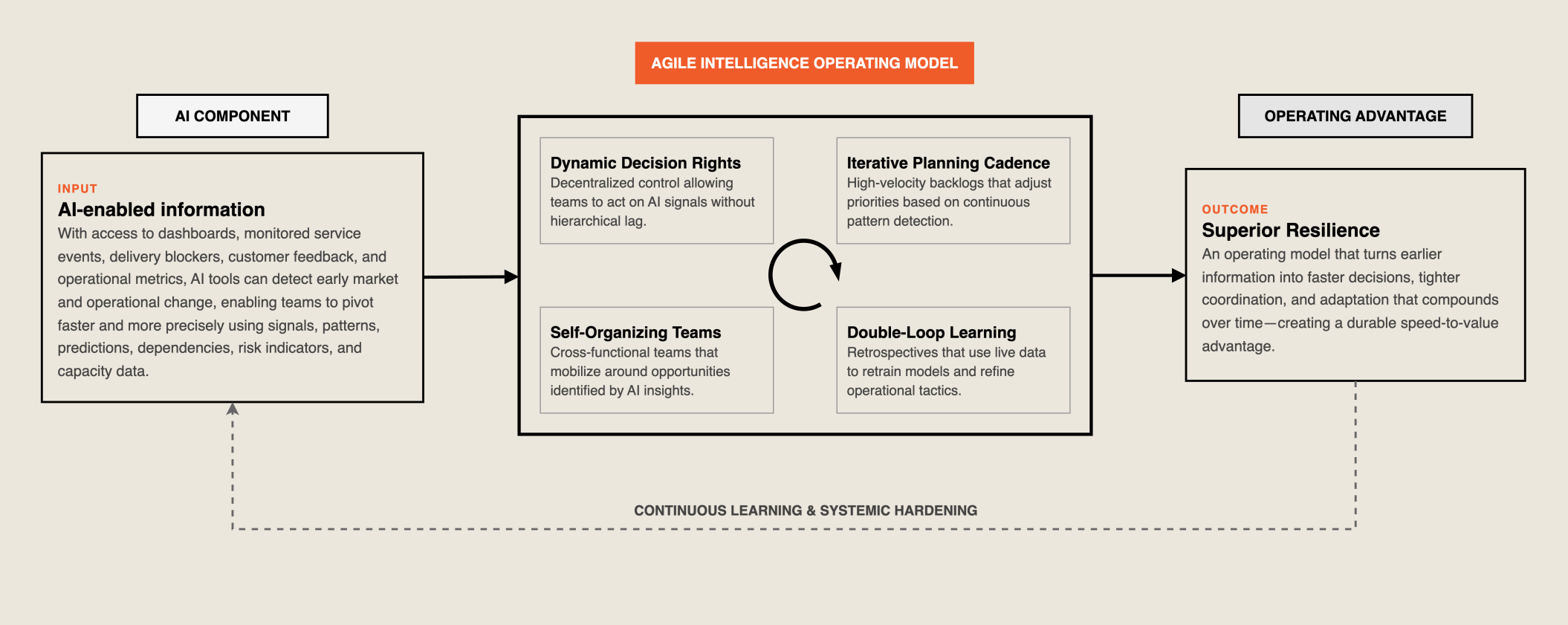
The model below makes the logic explicit. On the left, AI detects patterns, risks, dependencies, and opportunities earlier than manual observation usually can. In the middle, the operating model determines whether those signals change priorities, trigger decisions, and move teams in a coordinated way. On the right, the organisation captures the value: faster adaptation, tighter execution, and better resilience because it can respond while the information still matters.
Seen this way, the operating model is not a layer around AI. It is the mechanism that turns better sensing into better organisational performance. That is why the value question is really an operating question.
Where the operating model creates real value
Seen through that model, the added value of an Agile Intelligence operating model is not that it makes AI more impressive. It makes AI more useful. It gives the organisation the structural ability to turn earlier signals into better timing, better prioritisation, and better coordination. That is where the economic and operational value sits.
When that operating model is in place, organisations can identify delivery risk before it turns into missed commitments, adjust priorities while options are still open, reduce the drag of fragmented decision-making, and learn faster across teams because the same signal travels through a shared response path. AI stops being a disconnected layer of intelligence and becomes part of how the organisation runs.
Without that operating model, the opposite tends to happen. More information arrives, but it lands in slow planning cycles, unclear ownership structures, and disconnected forums. The result is not better performance. It is faster accumulation of unresolved signals. The difference becomes easiest to see in day-to-day operating situations.
What Agile Intelligence looks like in practice
If AI is going to improve operational performance, somebody needs the authority to act on what it reveals, teams need cadences that can absorb new signals quickly, and dependencies need to be explicit enough that action has somewhere to land. In practice, the difference between AI insight and operating advantage usually shows up in patterns like these.

A delivery risk is visible early. In a strong operating model, somebody owns the response and acts before delay turns into rework.

A new signal changes the priority logic. The organisation can re-prioritise while the information is still actionable, rather than waiting for a fixed planning window.

Several teams receive the same insight. Product, delivery, and operations move through a shared decision path instead of fragmenting the response.

AI exposes a recurring blocker. The organisation converts the pattern into a durable decision instead of leaving it as a discussion point.

Better information reaches the people who need to act. The system is designed to move with that information, so intelligence changes execution rather than merely enriching reporting. Taken together, these examples show that the difference is structural, not cosmetic.
The difference is structural. AI may improve the quality of information, but the operating model determines whether that improved information changes behaviour at the right time and at the right level. Once that is clear, the next implication follows: AI value depends less on adding more tools than on redesigning how the organisation operates with them.
The move from AI tooling to operating advantage
Building Agile Intelligence is therefore not mainly a technology project. It is an operating model project. The work is in clarifying decision rights, tightening the link between strategy and delivery, shortening review cadences, and making cross-functional coordination strong enough to turn faster signals into coordinated response.
That is also where the real value of AI in an organisation starts to show. Used inside an unchanged system, AI often makes existing friction more visible. Used inside an Agile Intelligence operating model, it helps the organisation sense earlier, decide faster, and adapt with less waste. That is the difference between smarter tooling and a genuine operating advantage. For organisations that want to make that shift, the practical question becomes where to redesign the operating model first.
Final thought: Agile Intelligence turns AI into operating advantage only when the organisation is built to respond. Better signals matter most in systems that can still act on them.
Where Filterdeck helps
At Filterdeck, we help organisations build the operating conditions that allow AI insight to become action. In practice, that work usually starts where the model is weakest: unclear ownership, slow portfolio decisions, backlog noise, delivery friction, weak service handoffs, or strategy that is not translating into coordinated execution.
The goal is not simply to help organisations use AI more often. It is to help them build an operating model that can absorb change faster, act with less friction, and convert better information into better performance.